

During Ganpati celebrations across India, families and communities spend considerable time planning visits, preparing invitations, sending personalised messages and creating festive images for friends and social media.
What is interesting is how quietly artificial intelligence has entered this process.
A Sr.Citizen our aunty may forward a creative invitation prepared with the help of AI, while a younger family member uses an AI tool to design a social media post. Neither may think of themselves as “AI users” in the technical sense. They are simply using a tool that helps them get something done faster.
That, perhaps, is one of the clearest indications of how rapidly AI has entered everyday life. It is no longer limited to technology companies or large corporations. It is increasingly becoming part of how ordinary people communicate, create and work.
Tasks that previously required considerable time or specialist support can now often be completed in minutes. Invitations, images, captions, presentations and basic research can all be assisted by readily available AI tools.
This ease of use is one reason adoption has spread so quickly across different age groups and professions.
I have seen this in my own consultancy work.
Over the past several months, I have used Microsoft Copilot for activities ranging from LinkedIn marketing and gathering subject insights to creating basic visual material. At home, my wife has used Gemini to create better visuals for her handcrafted products.
These may appear to be small examples, but they point toward a much larger opportunity—particularly for small and medium enterprises.
Large organisations have traditionally had an advantage when it comes to technology.
They can afford specialised teams for marketing, research, analytics, design, documentation and technology implementation. Smaller businesses often work with much leaner teams and limited budgets.
AI begins to change that equation.
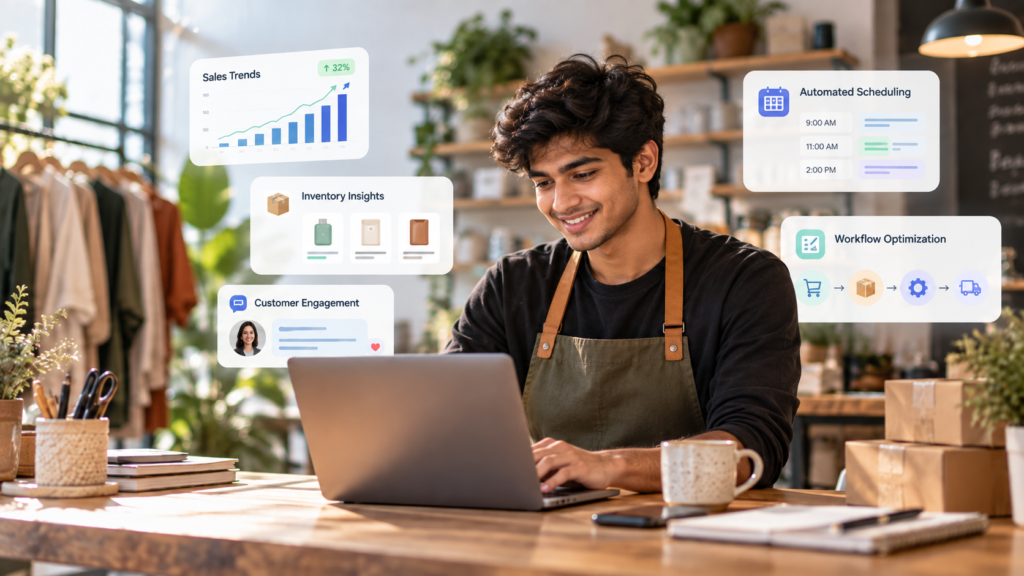
For many everyday business activities, an SME can now access capabilities that previously required additional people, external agencies or specialised software.
This does not mean that AI replaces expertise. What it does mean is that a small team can potentially accomplish much more with the resources already available to it.

The best way for a small business to approach AI may not be through a large transformation programme. It can begin with simple activities where AI saves time or improves productivity.
Marketing support
In my own work, I have used AI to assist with LinkedIn banners, carousels and captions. For a small company, this can make it easier to maintain a professional digital presence without requiring a large marketing or design team.
Information gathering
Business owners constantly need information—industry developments, regulatory changes, compliance requirements, finance trends and market developments. AI can help organise and summarise information quickly, allowing the user to begin research faster. The information should still be verified, particularly when business or regulatory decisions depend upon it.
Visual content creation
Simple illustrations, icons, presentation graphics and social-media visuals can now be created rapidly with AI tools. For smaller organisations that may not have an in-house designer, this can be particularly useful for presentations, reports, campaigns and everyday communication.
Documentation and reporting
This is perhaps one of the most practical uses of AI. Drafting emails, letters, job descriptions, meeting notes and reports can consume a significant amount of time. AI can help create an initial structured draft, which can then be reviewed and improved by the user.
In my consultancy practice, AI has already helped in preparing structured reports and minutes of meetings.
Campaign planning
AI can also act as a useful brainstorming partner. An SME planning a new campaign can use it to generate ideas, explore messaging, create an initial campaign structure and prepare supporting content.The result can be a more efficient workflow that allows business owners and employees to spend more of their time on customers, strategy and growth.
The convenience of AI should not make us careless.
AI-generated information is not automatically correct. Facts must be checked, documents must be proofread and important outputs should always be reviewed by a person who understands the subject. Sometimes an AI system may misunderstand the question, work from an unclear scope or simply take the conversation in a different direction from what the user intended. The real value therefore comes from treating AI as a supporting tool rather than an unquestioned authority.
AI can offer tremendous speed and help us work with large amounts of information. Human beings must still provide context, experience, judgment, creativity and empathy.
For SMEs, the most important aspect of AI may not be the technology itself.
It is the accessibility.
Capabilities that were once largely available to large organisations are increasingly becoming available to a small manufacturer, consultant, retailer, professional practice or family-run enterprise. A small business can use AI to communicate better, research faster, prepare documents more efficiently and create professional content without dramatically increasing its cost base.
That can help level the playing field.
The objective should not be to introduce AI merely because everybody is talking about it. The objective should be much more practical:
Find repetitive or time-consuming work, and determine whether AI can help your people perform that work better.
Start small. Learn from the results. Verify what the technology produces. And then gradually expand its use where it genuinely creates value.
Interestingly, this article itself has been developed with the assistance of AI.
Perhaps that illustrates the point better than anything else.
AI does not have to replace the person doing the work.
Used thoughtfully, it can help that person do more with the knowledge, experience and resources they already have.

CMA Prakash Sharma
Founder,
Paramarsh Management Consultancy
Prakash, writes from his experience as a consultant working with businesses and using AI tools in everyday professional activities.
The BharatEdge Contributor Series brings together independent perspectives from consultants, entrepreneurs, technologists and domain professionals exploring how AI and emerging technologies are changing business and industry.
The views expressed in this article are those of the contributor.